لطفا منتظر بمانید ...
0% Complete
صفحه اصلی
/
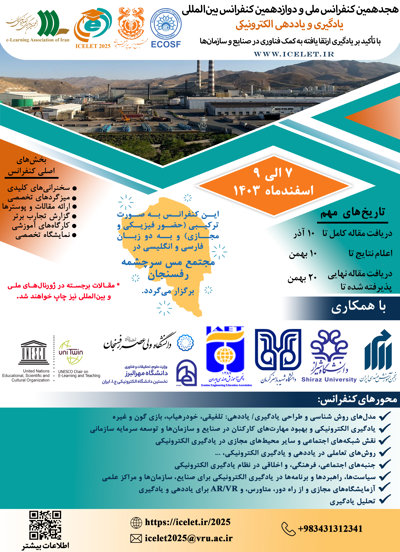
هجدهمین کنفرانس ملی و دوازدهمین کنفرانس بین المللی یادگیری و یاددهی الکترونیکی ایران
Learning Lessons from the UNITEL Project Module: Universities- Business Collaboration (An Overview and Some Experiences)
نویسندگان :
Seyed Komail Tayebi
1
Zahra Zamani
2
1- هیات علمی دانشگاه اصفهان
2- دانشگاه اصفهان
کلمات کلیدی :
UNITEL Project،Learning،Universities- Business Collaboration،Tradable Industries
چکیده :
Abstract—In this study, by focusing on the findings of the UNITEL Project Module: Universities- Business Collaboration (An Overview and Some Experiences), we have learned that fostering universities-business (industries) collaboration applies innovative teaching and learning strategies based on technology enhanced learning (TEL) and collaborative methodology so that the UNITEL project sought to address the current issues by putting into practice a working methodology to modernize STEM (Science, Technology, Engineering and Mathematics) education. Thus, conduction of a study on collaboration between universities and business (industry), as part of UNITEL Project, implies that such collaboration becomes a cornerstone of innovation and competitive advantages for economic development, entrepreneurship and industrial modernization. The primary goals of this paper are to review the conceptual discussion that the Module conducted and investigate the learning lessons that resulted from its findings. To reach out empirically these ends, we have developed an econometric framework of a trade gravity model to observe the estimated effects of Science and Technology (S&T) indicators on bilateral trade between Iran and Vietnam for 20 exporting goods groups (industries) during 1998-2022. The implication is that tradable industries benefit from investments in technology enhanced learning (TEL), which is a percentage of R&D expenditures and is proxied for an S&T indicator.
لیست مقالات
لیست مقالات بایگانی شده
Decoding Feedback in Online Learning: Five Theoretical Analogies and Their Implications
Zahra Zolfaghari - Abdollah Mehrfar - Zahra Karimian - Arash Bordbar
Analysis of Teaching and Learning in Moodle with the Help of Visualization with Power BI: Case Study of e-Learning Course of University of Tehran
Ali Khojastehfar - Seyyed Saeed Safai - Hossein Sabouri Abarbekouh - Omid Fatemi
چالش ها وچشم اندازهای به کارگیری اینترنت اشیادرآموزش وپروش
فاطمه السادات فاطمیون عقدا - امیر فروزنده
The effect of competing-based serious game on students' learning and academic engagement in writing course (Case study: serious Norland game)
Reza Hajihaji - Yusuf Mahdavi nasab - Abdullah Qasim Tabar
A study of the relationship between verbal immediacy and cognitive engagement in online learning
Seyed Abdollah Ghasemtabar - Seyed Amir Ghasemtabar - Yousef Mahdavinasab
Educational Escape Rooms: A Narrative Review of Design Frameworks in Higher Education
Leila Homayouni - Manoosh Mehrabi
A Critical Review of the Effect of Portfolio Assessment on Writing Anxiety, Performance and Autonomy
Mohsen Shahrokhi - Zahra Mohebati - Mozhgan Talebi
An analytical comparison of four education models: a faculty's and student's perspective
Taghi Javdani Gandomani - Mina Ziaei Nafchi
Promoting Learner Engagement and Enhancing Willingness to Communicate: A Project-based VR-assisted Course
S. Susan Marandi - Fatemeh Saneie Kashanifar
مقایسه اثربخشی روش های آموزشی سنتی، تعاملی و ترکیبی در بانک ملی ایران
محسن بیرامی - مجید دشتی رحمت آبادی - سارا لرستانی
بیشتر
ثمین همایش، سامانه مدیریت کنفرانس ها و جشنواره ها - نگارش 44.8.0